【Major Points】
- Postsurgical patients need to maintain proper hip posture. Avoid crossing legs, bending over to put on socks, squatting, picking up objects from the floor, or sitting on chairs that are too low.
- After returning to the ward post-surgery, if there is no nausea or vomiting, patients may drink water. If drinking water causes no discomfort, patients can proceed to eat.
- The day after hip replacement surgery, patients would be instructed by nursing staff while getting out of bed.
- If the skin of surgical site turns into red, swollen, oozes and warm, hip joint making abnormal noises, or if there is pain or difficulty while moving the joint, patients should return to hospital for further evaluation.
I. What is total hip replacement surgery?
Osteoarthritis and ischemic necrosis of femoral head are two common reasons for patient receiving total hip replacement surgery. Total hip replacement surgery involves the surgical removal of a diseased hip joint and replaced with an artificial joint.
II. Why is this surgery needed?
- To reduce pain and restore and improve joint range of motions.
- To enhance the overall quality of life.
III. Pre-surgical preparations
- Complete pre-surgery examinations, including chest X-rays, electrocardiograms, and blood tests.
- After the surgeon explains the purpose, process, and risks of the surgery, sign consent forms for the surgery, anesthesia, and blood transfusions.
- The night before surgery, adhere to the fasting instructions ordered by the surgeon. During the fasting period, do not eat any food or drink anything.
- Remove nail polish and avoid wearing makeup before the surgery to facilitate the monitoring of blood circulation.
- On the day of the surgery, change into surgical gown and remove dentures, as well as accessories such as necklaces, bracelets, rings, hairpins, watches, glasses, and contact lenses, before entering the operating room.
IV. Postoperative care principles
- Patients who do not experience nausea or vomiting after surgery can intake water, if no any discomfort after water, patient can intake meal without any restriction. Avoid smoking and drinking.
- Patients may have intravenous drips, urinary catheters, and wound drainage tubes post-surgery. When turning or moving, extra care should be taken to avoid dislodging or disturbing the drainage tube.
- If patients experience pain after surgery, please notify the nursing staff for appropriate intervention.
- The hip joint must maintain proper posture within three months after surgery. The precautions are as follows:
- The hip joint should remain an abduction position. To maintain this posture, place a pillow between legs when lying down or turning (as Figure 1 and Figure 2). Avoid crossing the legs (as Figure 3).
- Keep the hip from bending more than 90 degrees to prevent dislocation of the artificial hip joint. Ensure the angle between the body and the affected limb remains over 90 degrees. Refrain from leaning forward, bending to put on socks, picking up objects, squatting, or sitting on low chairs (as Figure 4).
- Under the guidance of medical and nursing staff, perform ankle and quadriceps contractions, as well as straight leg-raising exercises (as Figure 5).
- The day after surgery, nursing staff will assist patients while getting out of bed and guide them to use crutches or walkers. Follow the surgeon’s instructions regarding weight-bearing on the operated limb. If the limb is permitted to bear weight fully, patients can step normally on the ground while walking.
Figure 1.Lying on
your back with a pillow placed between your legs
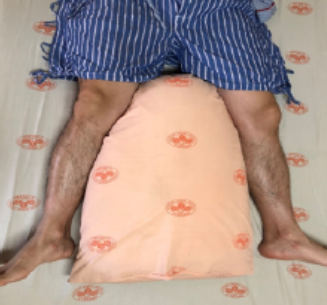
Figure 2. Lying on your side with a pillow placed between your legs
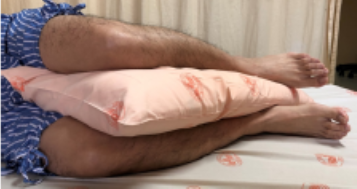
Figure 3. Avoid crossing your feet
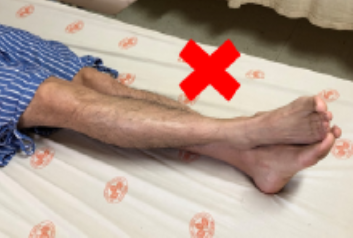
Figure 4. Ensure that the angle between the body and the affected limb is not less than 90 degrees to avoid leaning forward.
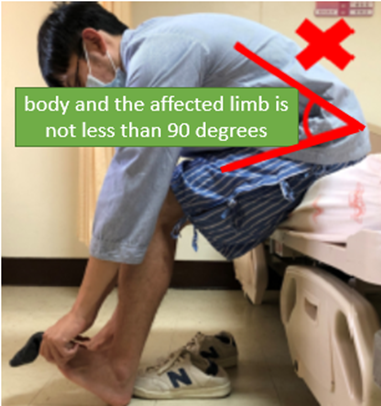
Figure 5. Rehabilitation exercises
|
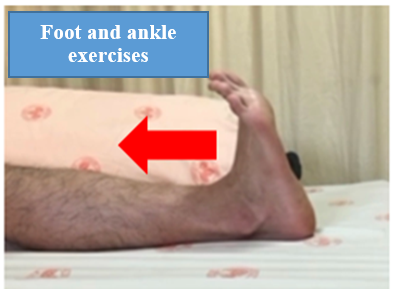 |
Slowly raise your ankle, hold for 10 seconds, then lower it slowly. Begin these exercises as soon as you wake up after surgery, performing them ten times every hour.
|
|
|
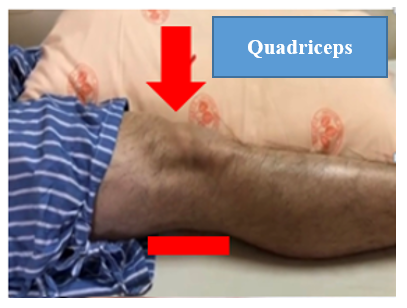 |
Lie flat on your bed. Press your knees down, tighten your thigh muscles for five seconds, then relax for five seconds. Repeat ten times to strengthen your hip and thigh muscles. |
|
|
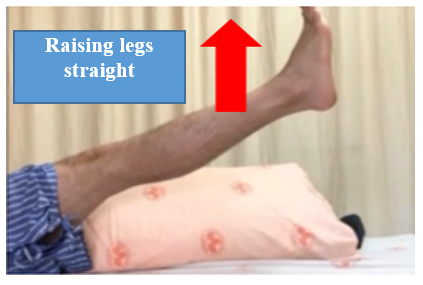 |
Lift your surgical leg, hold for five seconds, then lower it slowly. Repeat ten times to strengthen your hip and thigh muscles. |
V. Home care precautions
- Keep the wound clean and dry, and avoid exposing it to water. Return to your surgeon ten days to two weeks after surgery for an evaluation and suture removal before taking a bath. Showers are recommended.
- Continue performing the rehabilitation exercises taught during your hospital stay.
- Use a walker or crutches for walking and ensure safety to prevent falls.
- Keep the hip joint abducted and avoid bending more than 90 degrees for three months. Be mindful of daily postures to prevent dislocation of the artificial hip joint.
- If the skin of surgical site turns into red, swollen, oozes, warm, making abnormal noises, or if there is pain and inability to move the hip due to a fall, ask treatment at an orthopedic clinic.
References:
- Guo, J., & Zhang, Z. (2025). Effects of predictive nursing process on elderly patients with total hip arthroplasty. Rejuvenation Research, 28(2), 37–44. https://doi.org/10.1089/rej.2024.0059
- Liu, G., Li, L., Deng, J., Cai, L., & He, R. (2025). Enhanced recovery after surgery: Nursing strategy for total hip arthroplasty in older adult patients. BMC Geriatrics, 25(1), 282. https://doi.org/10.1186/s12877-025-05888-8
- Yuan, S.J. (2024). Nursing care of musculoskeletal system disorders. In H.E. Liu (Chief Ed.), Adult medical-surgical nursing (9th ed., Vol. 2, pp. 507–658). Farseeing Publishing.
- Zhou, Y., Bao, Y., Kan, Y., Lv, S., Yan, K., Hua, D., & Chen, Q. (2025). Evaluation of early rehabilitation intervention-based nursing care in total knee arthroplasty. Medicine, 104(32), e43319. https://doi.org/10.1097/MD.0000000000043319
Attachment(s):
Evaluation
Please answer the following questions:
Nursing Instruction Satisfaction
The statistical results are not open to the public.
Please log in to rate
- Location
-
- Category
- Surgery / Procedure

Taipei Veterans General Hospital
No.201, Sec. 2, Shipai Rd., Beitou District, 
Taipei, Taiwan 11217, R.O.C.
Tel: +886-2-2871-2121 #04
- Smoking and chewing betel nut significantly induce oral cancer. Obesity will potentially increase the risk of breast cancer and colorectal cancer. Please control body weight and keep away from tobacco and betel nut.
- Information provided above can’t overcome physician's treatment and replace physician patient relationship.
© Copyright 2020 by Taipei Veterans General Hospital Nursing Department.
All rights reserved.
All rights reserved.