【Major Points】
- Painless labor involves administering pain-relieving medication into the epidural space in the posterior lumbar region.
- This helps alleviate the pain of labor, although it does not provide complete pain relief.
- Following the injection, may get symptoms such as decreased blood pressure, nausea, vomiting, and a reduced urge to urinate.
- Painless labor can impact the fetal heartbeat, it is necessart to monitor the fetal heart rate continuously.
1. What is painless labor?
An anesthesiologist administers an anesthetic drug into the lumbar epidural space, located between the vertebrae in the lower back, to a woman preparing to give birth. This blocks the transmission of pain signals and reduces the discomfort caused by uterine contractions during labor.
2. Why is painless labor needed?
Once regular contractions begin, you may experience pain in the lower abdomen and soreness in the lower back. When the pain becomes difficult to tolerate, you may consider receiving painless labor. The timing of the procedure will be jointly assessed by the obstetrician and the anesthesiologist. After administration, it can help reduce the pain experienced during labor.
The doctor will also evaluate the mother’s physical condition. If there are abnormalities in blood clotting (the blood cannot clot normally), allergies to anesthetic medications, or a history of back surgery, painless labor may not be suitable.
3. Preparation before painless labor:
- Painless labor is a self-pay item. Once you decide to proceed, you will need to complete the anesthesia and payment consent forms.
- Nursing staff will set up monitoring equipment for the expectant mother. This includes close monitoring of blood pressure, blood oxygen level, heart rate, and fetal heartbeat.
4. How does painless labor proceed:
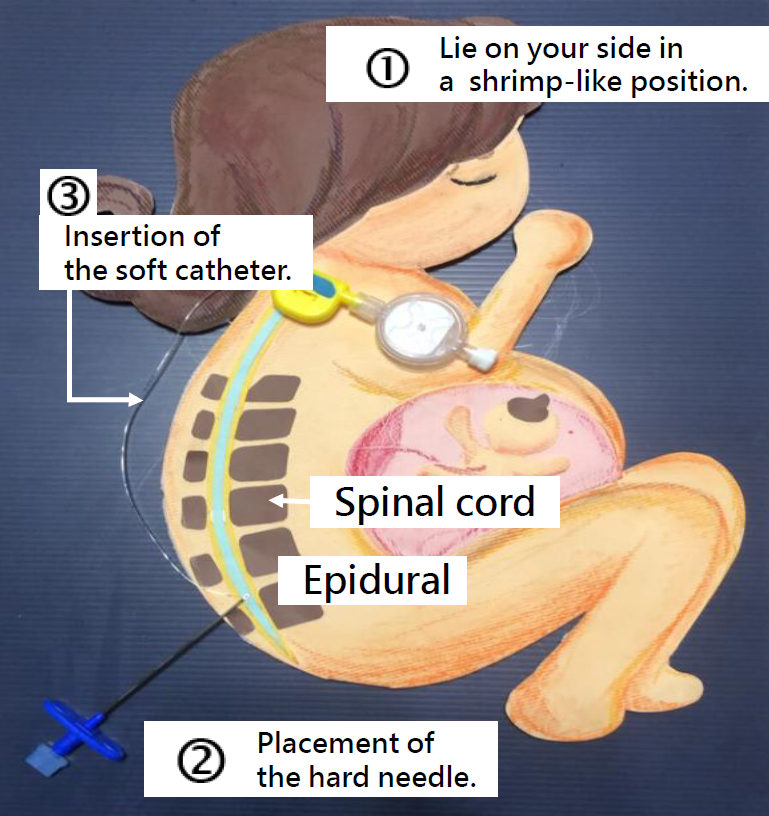
You will need to lie on your side with your knees bent towards your chest, allowing your back arch like a boiled shrimp. The doctor will start by administering local painkillers, then insert the injection tube into the epidural space of the lower back’s vertebrae, connecting it to a medication injector. A thin tube will extend outward and adhere to your back at this point(Figure 1).
Afterward, pain relief medication will be administered through this tube. Once the procedure is completed, you may choose a comfortable lying position. There is no need to worry about pressing on or dislodging the tube.
5. Nursing care instructions after painless labor:
- After receiving painless labor, the expectant mother may experience side effects such as lowered blood pressure, nausea, vomiting, itchy skin, shivering and headache. If you feel unwell, please inform healthcare personnel immediately.
- The fetal heartbeat may change due to painless labor, necessitating continuous monitoring of the fetus’ condition.
- Painless labor can effectively alleviate pain, but it may not provide 100% pain relief, and could decrease the expectant mother’s urge to urinate. Even if the bladder is full, she might not feel the need to urinate. In such cases, a nurse may insert a temporary urethral tube for smooth urine drainage. Typically, this tube will not be left in place continuously.
- After receiving painless labor, some mothers may experience slowed or weakened motor responses. Therefore, mothers who have received painless labor and are continuing pain medication are not advised to get out of bed. For those who are no longer receiving continuous pain medication, medical staff will assess leg strength before allowing them to get up and walk. If walking is permitted, a family member should accompany the mother to prevent falls.
- Painless labor may slightly prolong the duration of labor, and mothers may feel a reduced urge to push, which could result in a slightly longer pushing stage. However, painless labor does not increase the likelihood of requiring delivery assistance tools (such as vacuum extraction or forceps) or the chance of a cesarean section. Medical staff will closely monitor the progress of labor and provide necessary assistance throughout the process.
- In addition to painless labor, nurses will also use various methods during labor to help mothers feel more comfortable and support a smoother delivery.
Reference
- Halliday, L., Nelson, S. M., & Kearns, R. J. (2022). Epidural analgesia in labor: A narrative review. International Journal of Gynecology & Obstetrics, 159(2), 356-364. https://doi.org/10.1002/ijgo.14175
- Ozdemir, S., Chen, T., Tan, C. W., Wong, W. H. M., Tan, H. S., Finkelstein, E. A., & Sng, B. L. (2022). Parturients’ Stated Preferences for Labor Analgesia: A Discrete Choice Experiment. Patient preference and adherence, 983-994. https://doi.org/10.2147/PPA.S353324
- Tseng, Y. F., Chen, C. F.& Wan, M. I. (2021). Nursing of Women during Childbirth. In M. L. Gau(Eds.), Practical Obstetric and Gynecologic Nursing (9th ed., p. 308-310). Farseeing.
Evaluation
Please answer the following questions:
Nursing Instruction Satisfaction
The statistical results are not open to the public.
Please log in to rate
- Location
-
- Category
- Examination / Therapy

Taipei Veterans General Hospital
No.201, Sec. 2, Shipai Rd., Beitou District, 
Taipei, Taiwan 11217, R.O.C.
Tel: +886-2-2871-2121 #04
- Smoking and chewing betel nut significantly induce oral cancer. Obesity will potentially increase the risk of breast cancer and colorectal cancer. Please control body weight and keep away from tobacco and betel nut.
- Information provided above can’t overcome physician's treatment and replace physician patient relationship.
© Copyright 2020 by Taipei Veterans General Hospital Nursing Department.
All rights reserved.
All rights reserved.