【Major points】
- Bone marrow tissue is collected to help diagnose disease and evaluate the effectiveness of treatment.
- Children receiving general anesthesia should not eat or drink for 8 hours before the examination.
- After the bone marrow aspiration, lie flat for 2 hours and apply pressure to the puncture site until there is no bleeding.
- Keep the puncture site dry for 24 hours after the bone marrow aspiration to help prevent wound infection.
- You may experience soreness after the examination. If the pain is severe or cannot be tolerated, please inform the healthcare staff.
What is a bone marrow aspiration and biopsy?
A bone marrow aspiration and biopsy is a procedure in which a special needle is used to collect bone marrow fluid or bone marrow tissue from the iliac bone for examination. It is a safe, convenient, and effective way to evaluate bone marrow function.
Why is this examination needed?
The collected bone marrow fluid or tissue is examined to evaluate bone marrow function, blood cell morphology, and chromosomes. The results are used for diagnosis and treatment follow-up.
What should be prepared before the examination?
- Before the procedure, the doctor will explain the purpose and process of the bone marrow aspiration and biopsy to the child and family.
- The examination consent form must be completed by a legal guardian; if anesthesia is required, an anesthesia consent form must also be completed.
- Children receiving general anesthesia must have nothing to eat or drink for 8 hours before the examination to prevent vomiting and aspiration pneumonia. Children receiving local anesthesia may eat normally.
- Before the examination, ask the child to empty their bladder. If the child has an indwelling urinary catheter, empty the urine bag before the procedure.
- The bone marrow aspiration and biopsy will be performed in the treatment room on the ward. Family members may wait outside the treatment room or in the patient's room.
How is the examination performed?
-
The examination will be performed in the ward treatment room. Family members may wait in the patient's room. After the examination, the healthcare staff will return the child to the room.
-
During the examination, the child will lie face down with the buttocks exposed for disinfection and the procedure.
-
The child may feel soreness or numbness during the examination. The healthcare staff will monitor the child and provide assistance as needed.
(For more information, please watch the bone marrow aspiration and biopsy video.)
What should be noted after the examination?
-
Post-examination positioning for the Child, see Figure 1:
- Lie flat in bed for 2 hours.
- Place a sandbag over the gauze at the puncture site until the bleeding stops. If you notice any bleeding or oozing from the wound, inform the healthcare staff immediately.
- If the child received general anesthesia, turn the child's head to one side until fully awake to prevent aspiration if vomiting occurs.
- After the child is fully awake, start with a small amount of water. If there is no vomiting or choking, the child may resume a normal diet.
- Care for the puncture site:
- Keep the puncture site and dressing dry for 24 hours to help prevent wound infection.
-
Remove the dressing after 24 hours.
-
Mild soreness at the puncture site is normal for 2–3 days.
-
Inform the healthcare staff immediately if any of the following occur:
The wound or gauze accidentally gets wet.
The wound bleeds again or has discharge.
The wound pain does not improve, becomes worse, or is unbearable.
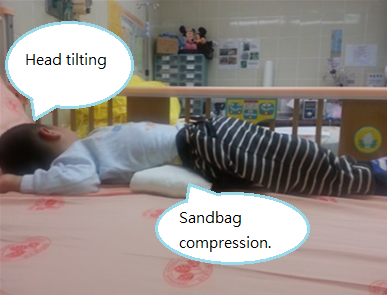
Figure 1 post-examination posture
Reference
- Elgazar, S., & Constantinou, C. (2024). Paediatric acute lymphoblastic leukaemia: A narrative review of current knowledge and advancements. Current Oncology Reports, 26(12), 1586-1599. https://doi.org/10.1007/s11912-024-01608-4
- Lin, M. H., Wu, S. Y., Wang, K. J., & Tseng, C. Y. (2023). Chapter 9: Nursing care of children with hematologic disorders. In Y. C. Chen (Ed.-in-Chief), Practical pediatric nursing: Fundamental perspectives (1st ed., pp. 389–390). Fahan.
- Nakamura, T., Nakagawa, S., Horikawa, S., Nagahama, J., Yasudome, Y., Abematsu, T., Kodama, Y., Nishikawa, T., & Okamoto, Y. (2025). Safety and efficacy of sedation for pediatric patients with cancer and developmental disabilities. Pediatrics International, 67(1), e70142.
Evaluation
Please answer the following questions:
Nursing Instruction Satisfaction
The statistical results are not open to the public.
Please log in to rate
- Location
-
- Category
- Examination / Therapy

Taipei Veterans General Hospital
No.201, Sec. 2, Shipai Rd., Beitou District, 
Taipei, Taiwan 11217, R.O.C.
Tel: +886-2-2871-2121 #04
- Smoking and chewing betel nut significantly induce oral cancer. Obesity will potentially increase the risk of breast cancer and colorectal cancer. Please control body weight and keep away from tobacco and betel nut.
- Information provided above can’t overcome physician's treatment and replace physician patient relationship.
© Copyright 2020 by Taipei Veterans General Hospital Nursing Department.
All rights reserved.
All rights reserved.